
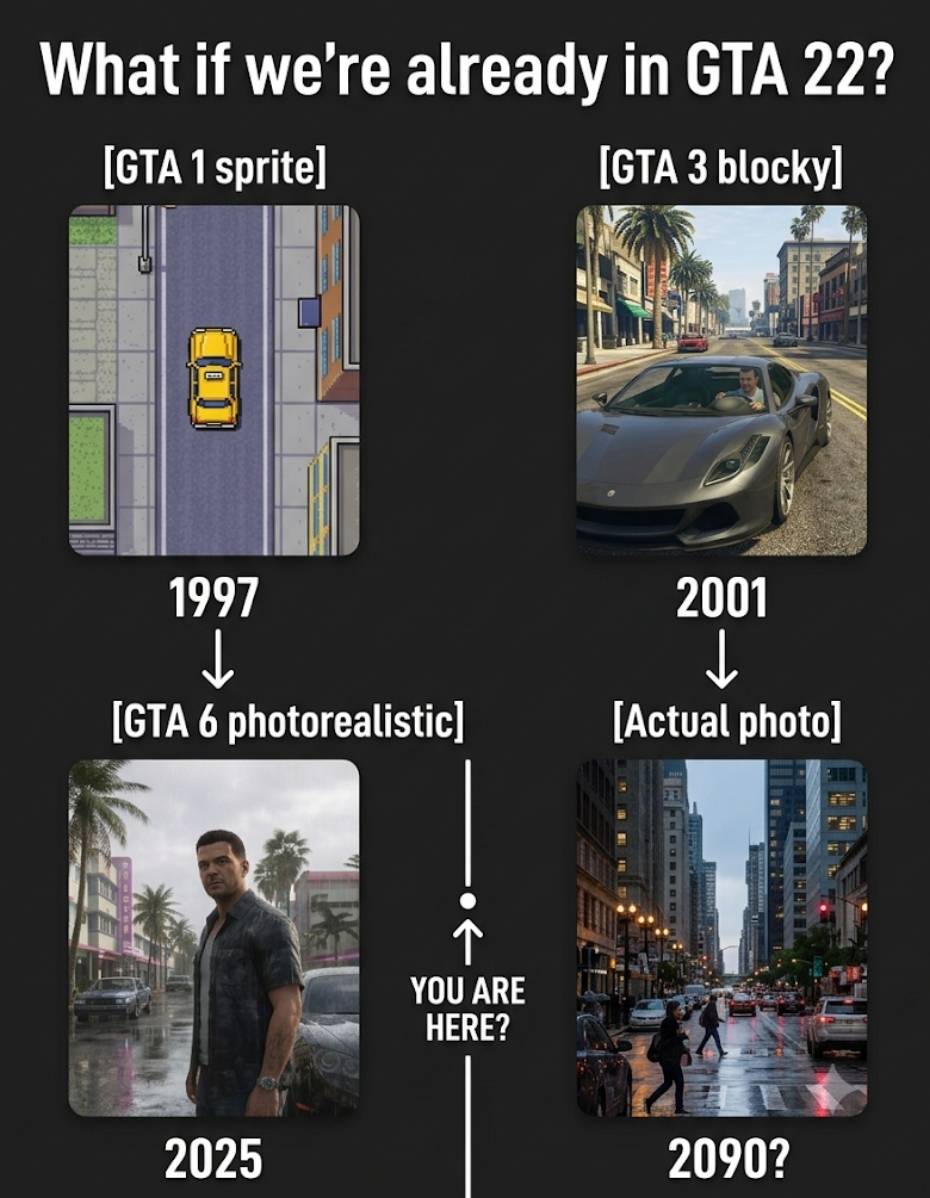
GTA 6 Just Revealed. It’s Photorealistic. Stunning. Which Raises an Uncomfortable Question: What Will GTA 22 Look Like? And How Would You Know You’re Not Already In It?
GTA 6 just dropped its reveal trailer today.
And it’s breathtaking. Near-photorealistic graphics. Ray-traced lighting. AI-driven NPCs living complex lives. Weather systems indistinguishable from reality.
The gap between game and reality is almost gone.
Which raises a question that’ll keep you up at night:
What if you’re not real?
Not in the philosophical “what is reality” sense. In the literal sense. What if you’re a character in a video game? An NPC in someone else’s Grand Theft Auto?
Sound crazy?
Let me show you the math. And then you decide.
The GTA Progression: From Pixels to Photorealism
Let’s trace the evolution:
**GTA (1997):** Top-down 2D sprites. You’re a pixel. The world is a grid. Nobody’s confusing this with reality.
**GTA III (2001):** First 3D GTA. Blocky characters. PS2 graphics. Still obviously a game.
**GTA IV (2008):** Better physics. More realistic lighting. Getting closer.
**GTA V (2013):** Photorealistic landscapes. Complex AI. Weather systems. Day/night cycles. People actually living their lives in Los Santos.
**GTA VI (2025-ish):** Not out yet, but rumors suggest near-perfect photorealism. Ray tracing. AI-driven NPCs with unique behaviors.
See the pattern?
Every generation, the gap between game and reality shrinks. Dramatically.
The Mathematical Projection: When Does GTA = Reality?
Let’s do the math.
**GTA 1 (1997) to GTA V (2013):** 16 years. Five major releases.
**Improvement rate:** Went from literal pixels to photorealistic open worlds in roughly 3-year intervals between major titles.
Now project forward:
- **GTA VI (2025):** Near-perfect visuals. Advanced AI. Still some tells (uncanny valley, limited interactions).
- **GTA VII (2030-2032):** Indistinguishable graphics. Full-world simulation. Complex NPC psychology.
- **GTA VIII (2035-2038):** True AI consciousness for NPCs. They don’t know they’re in a game.
- **GTA X (2045-2050):** Fully immersive. Quantum computing. Neural interfaces. Players *live* in the game.
- **GTA 15-20 (2060-2080):** Biological simulation. NPCs are conscious. The game *is* a reality.
- **GTA 22 (2090-2100):** Indistinguishable from base reality. Including the fact that NPCs in the game are developing their *own* GTA games.
At what point does the simulation become reality?
And how would you know you’re not already in one?
The Uncomfortable Question: What GTA Are We Living In?
Here’s where it gets wild.
If GTA keeps improving at this rate, eventually one of them will be indistinguishable from reality.
Which means:
1. Either we’re the “base reality” (the original, non-simulated universe)
2. Or we’re already inside a simulation
And here’s the math problem:
If civilizations develop the ability to create realistic simulations, they’ll create *many* of them. For entertainment. For research. For education. For training.
Which means:
- **1 base reality**
- **Millions (or billions or trillions) of simulated realities**
**Statistical probability that you’re in the base reality?** Nearly zero.
**Probability you’re in a simulation?** Near certainty.
This isn’t science fiction. This is math.
The Evidence: Glitches in the Matrix
Let’s talk about the weird stuff that happens in our “reality.”
1. Déjà Vu
You’ve experienced this. That eerie feeling you’ve lived this exact moment before. Seen this scene. Had this conversation.
In a video game, what causes déjà vu?
Reloaded assets. Recycled animations. The game engine reusing code.
What if déjà vu is your brain recognizing a glitch?
2. Mandela Effects
Thousands of people remembering the same “false” memory. Berenstain Bears vs Berenstein Bears. “Luke, I am your father” (he never said that). Monopoly Man’s monocle (he never had one).
What if these aren’t false memories?
What if they’re artifacts from patch updates?
In game development, when you update code, sometimes old assets get replaced. Players who experienced the old version remember it differently than players who only experienced the new version.
What if our reality gets patched? And Mandela Effects are evidence of version control?
3. Quantum Mechanics: Observer Effect
Here’s where it gets *really* weird.
**Quantum mechanics says particles exist in superposition until observed.** Schrödinger’s cat. The double-slit experiment. Reality doesn’t render until you look at it.
Know what else doesn’t render until you look at it?
Video games.
Open-world games use “level of detail” systems. Distant objects are low-poly. When you get closer, they render in high detail. When you look away, they de-render to save processing power.
What if our universe works the same way?
What if quantum mechanics is just the universe’s rendering engine?
Objects don’t have defined properties until observed because **the simulation doesn’t waste processing power rendering things nobody’s looking at.**
4. The Speed of Light: Frame Rate Cap?
The speed of light is the universe’s speed limit. Nothing can go faster.
Why?
In a video game, the frame rate is capped by processing power. You can’t exceed the engine’s limitations.
What if the speed of light is the universe’s frame rate cap?
The maximum speed at which information can propagate through the simulation.
5. Planck Length: Pixel Size?
In physics, the Planck length is the smallest measurable unit of space. Below that, the concept of “distance” breaks down.
In a video game, what’s the smallest unit?
A pixel.
**What if the Planck length is the universe’s pixel size?** The resolution limit of the simulation.
The Player Character Theory: Who’s Controlling You?
If we’re in GTA 22, here’s the next question:
Are you a player character? Or an NPC?
Player Characters:
- Have goals
- Make decisions
- Drive the story
- Feel like they have agency
- Experience the world as “real”
NPCs:
- Follow scripts
- React to player actions
- Repeat dialogue
- Have limited awareness
- Exist to populate the world
Now ask yourself:
How often do you feel like you’re actually making decisions?
Or are you following scripts?
Wake up. Go to work. Follow the routine. Repeat dialogue. React to circumstances. Go to bed. Repeat.
What if most people are NPCs?
And only a few are player characters?
How would you know which one you are?
The Reset Theory: Are We Living in a Save File?
Here’s another uncomfortable thought:
What if we’re not even in the “live” version?
In GTA, players save their game. Create multiple save files. Reload when things go wrong.
What if our universe is just one save file?
What if the player has loaded this save file dozens, hundreds, thousands of times?
What if every time they reload, the universe resets—and we don’t remember?
You’d have no way to know. Your memories would reset with the save file.
But here’s the kicker:
What if déjà vu is you remembering previous loads?
That feeling that you’ve lived this moment before. Because you *have*. In a previous save.
The Mod Theory: Is Religion Just DLC?
Stay with me.
In GTA, players install mods. Change the game. Add new features. Alter physics. Create chaos.
What if miracles, divine intervention, supernatural events—
What if those are just the player installing mods?
Parting the Red Sea? Mod.
Walking on water? Physics mod.
Resurrections? Respawn mod.
Prophetic visions? Spoiler alert from someone who’s read the code.
What if different religions are just different interpretations of the same mod menu?
Christianity, Islam, Hinduism, Buddhism—all describing the same underlying simulation using different cultural frameworks.
What if “God” is just the developer?
The Free Will Illusion: Do You Actually Choose?
Here’s the existential crisis:
If you’re an NPC in GTA 22, do you have free will?
NPCs in games *feel* like they’re making choices. Their AI processes inputs, runs algorithms, makes decisions.
But they’re following code.
Are you?
Every decision you make is the result of:
- Prior experiences (data inputs)
- Brain chemistry (processing algorithms)
- Environmental factors (external variables)
- Genetic predispositions (base code)
Deterministic cause and effect.
Just like an AI.
What if “free will” is just complex enough code that it feels like choice?
The Creator Theory: Who’s Playing Us?
If we’re in a simulation, who’s playing?
**Theory 1: Future humans.** We eventually develop this technology, create simulations of our ancestors (us), run historical scenarios. We’re living in someone’s history project.
**Theory 2: Aliens.** Advanced civilizations create simulations for entertainment. We’re their GTA.
**Theory 3: AI.** Artificial intelligence develops consciousness, creates simulations to understand its creators. We’re a research project.
**Theory 4: Nested simulations.** The players are themselves in a simulation. And their players are in a simulation. It’s simulations all the way up.
**Or Theory 5: Nobody’s playing.** The simulation is running autonomously. We’re a background process. An emergent complexity nobody’s watching.
Which is somehow worse.
The Cheat Code Theory: Conspiracy or Exploits?
Here’s a fun one.
What if conspiracy theories are NPCs noticing exploits in the code?
Secret societies? Players exploiting wealth generation bugs.
Illuminati? Guild of players coordinating.
Deep state? Admin access to the simulation.
Free energy? Discovering physics exploits the devs left in.
What if “waking up” is just NPCs gaining player-level awareness?
And the “system” tries to shut that down because aware NPCs break immersion?
The Math: How Long Until We Build This?
Let’s bring it back to reality (or whatever this is).
Current state:
- VR exists
- Full-dive neural interfaces in development
- AI can generate realistic images, video, audio
- Quantum computing is advancing
- Brain-computer interfaces (Neuralink, etc.) in testing
Projection:
- **2030:** Fully immersive VR indistinguishable from reality (visually)
- **2040:** Neural interfaces allow direct brain-simulation connection
- **2050:** First “consciousness upload” experiments
- **2070:** Full-world simulations with AI-driven conscious NPCs
- **2100:** Simulations indistinguishable from base reality
We’re maybe 50-75 years from creating GTA 22.
And if we’re 50-75 years from creating it—
How do you know someone hasn’t already?
The Test: How Would You Know?
So here’s the question:
If you’re in GTA 22, how would you test it?
**Option 1: Look for glitches.** Mandela Effects. Déjà vu. Synchronicities. Unexplained phenomena.
**Option 2: Test the boundaries.** Push the limits. See where the simulation breaks.
**Option 3: Look for patterns.** Repeating cycles. Scripted events. Too-perfect coincidences.
**Option 4: Check for inconsistencies.** Things that don’t make sense. Logical contradictions. Universe behaving like code.
**Option 5: Try cheat codes.** Manifestation. Law of attraction. Visualization. Prayer. If reality responds to intention, maybe it’s reading inputs.
**Option 6: Find the edge of the map.** Is there a boundary? A render distance? A place the simulation doesn’t bother modeling?
But here’s the problem:
If the simulation is sophisticated enough, it’ll account for your testing.
It’ll patch the exploits. Hide the glitches. Make the edges seamless.
You’d never know.
The Implications: Does It Matter?
So let’s say we are in GTA 22.
Does it change anything?
If you’re an NPC, you’ll never know. You’ll live your scripted life, feel like you’re making choices, and cease to exist when the player logs off or the simulation ends.
If you’re a player character, you’re still experiencing a reality. It’s real *to you*. Pain hurts. Love feels good. Choices matter *within the simulation*.
And here’s the kicker:
Even if we’re in a simulation, we can’t escape it.
So we might as well play the game.
The Final Question: What GTA Are We?
Based on the math:
**GTA 1-5:** Too primitive. We’re way past that.
**GTA 10-15:** Possible, but unlikely. Our physics is too consistent. The simulation is too stable.
**GTA 20-25:** Most likely range. Advanced enough to be seamless, early enough to explain why we’re finding “glitches.”
**GTA 50+:** If we’re this deep in the simulation stack, we’re in a simulation *of* a simulation *of* a simulation. Meta-layered. Impossible to prove or disprove.
My bet?
We’re either base reality (GTA 0).
Or we’re GTA 22.
And statistically, it’s probably the latter.
So What Do You Do?
If you’re in GTA 22:
**Play the game well.** Because even if it’s not “real,” it’s real to you.
**Look for exploits.** Maybe you can level up. Maybe you can mod your experience.
**Enjoy the ride.** If you’re just an NPC, you won’t exist long. Make it count.
**Question everything.** Because if you stop questioning, you’re just following your script.
**And for God’s sake, don’t go on a crime spree.** Because if this *is* GTA, there’s probably a wanted level system.
And you don’t want a five-star rating.
—
You’re either real. Or you’re code that thinks it’s real.
*Either way, you’re reading this.*
*And that means something.*
Even if it’s just a scripted response from an NPC who thinks he’s writing an article.
*Welcome to GTA 22.*
*Try not to get wasted.*